
I had a wonderful time attending the first annual Pedagogical Wellness Day Conference, hosted by the University of California, Irvine. The conference explored the intersections of teaching excellence, student care, and faculty/ staff holistic wellness. There was lots of time for connection and networking with professors and student success staff from across the country.
A favorite session was the keynote, presented by psychologist Dr. Sarah Pressman. She shared her research on “The Resilient Classroom: Integrating the Science of Wellbeing into Course Design.” Dr. Pressman emphasized that stress in itself is not a problem to be solved. At times there have been misapplications of pedagogical wellness that seek to remove any feelings of stretching, challenge, or uncertainty. In contrast, Dr. Pearlman provided strategies for embedding student choice and support within activities that pull students outside their comfort zones.
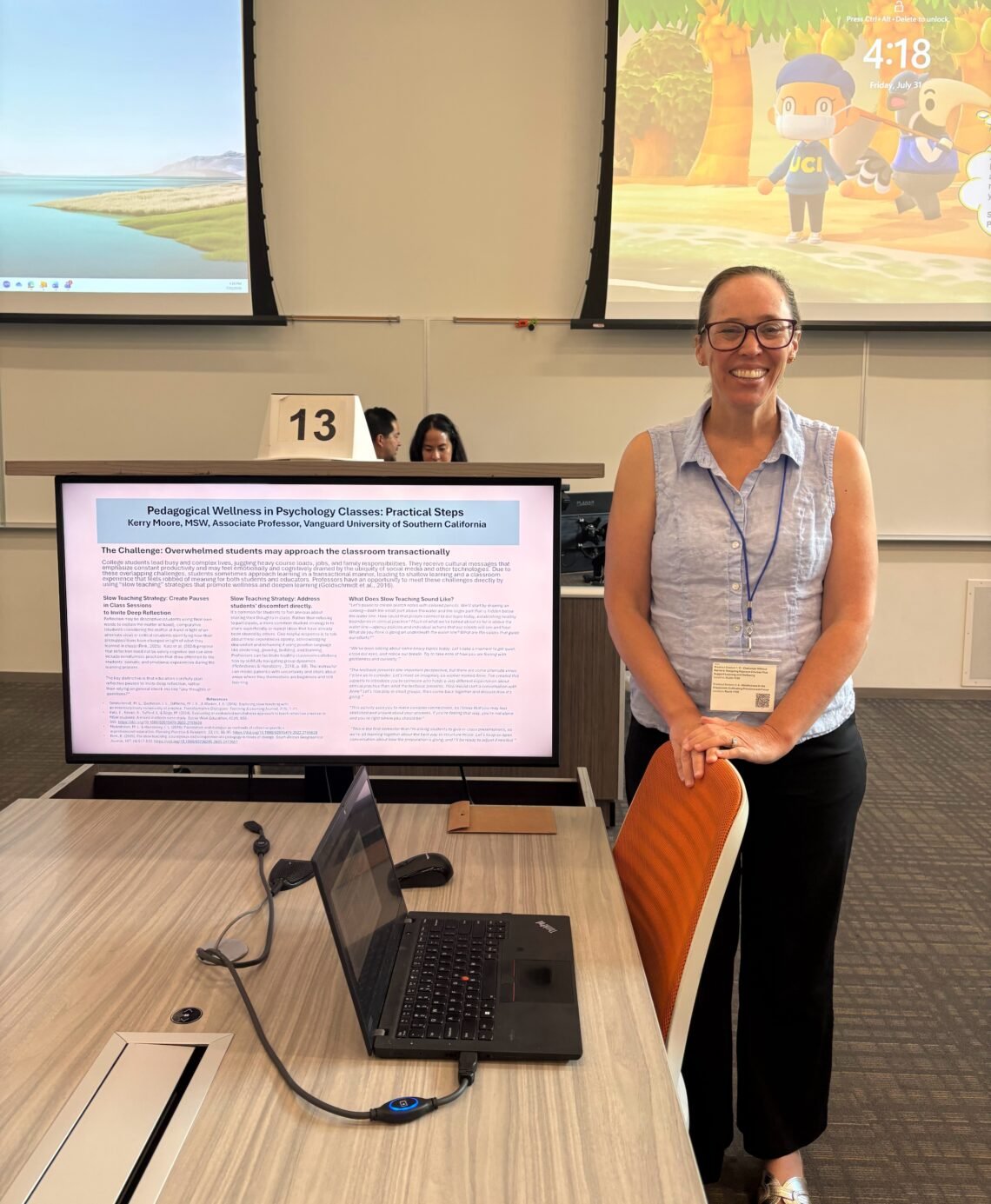
I presented a poster at the conference entitled “Pedagogical Wellness in Psychology Classes: Practical Steps.” The poster synthesized existing research and moved into practical application within the context of undergraduate psychology courses. In comparison to students 10 or 15 years ago, I find that our current group of students is more likely to interpret the normal challenges of learning (struggling to understand a reading assignment, having questions, feeling unsure about creating their own arguments) as evidence that something is wrong. In response to this shift, I’ve been experimenting with more directly talking with students about what the process of learning looks like and feels like. This can be as simple as normalizing their experience and confirming next steps. It sounds something like this: “After reading through the case study, you may be feeling that you have a basic understanding of the client’s concerns, but aren’t sure what interventions would be helpful. That’s normal! It’s really challenging to make the move from understanding a problem to conceptualizing a response. If you’re feeling stuck, why don’t you turn to a classmate and do some brainstorming together. Then we’ll share our ideas with the larger group and work together to identify the strongest plan.”
I felt inspired by a psychology professor that I met at the conference who has recently taken up rowing, and uses her own learning experiences in the boat as an example for students. I’ve been doing the same thing in my classes—talking with students about areas where I am a beginner and what it’s like for me to feel unsure, try, struggle, and try again.