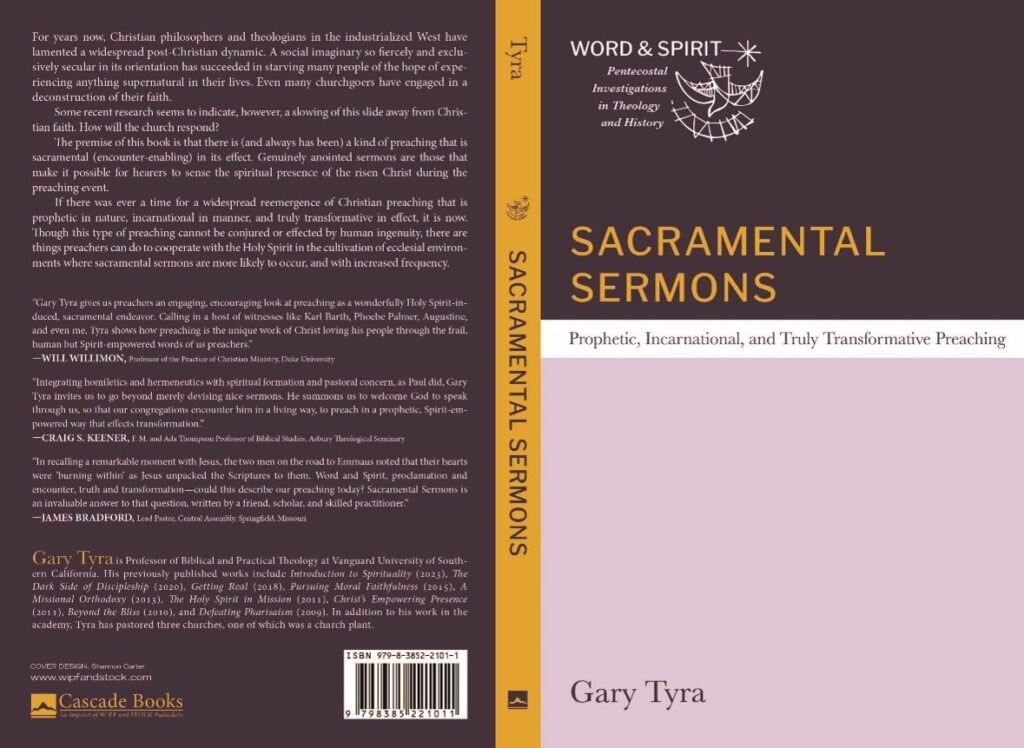

I recently presented a paper at the annual meeting of the Society for Pentecostal Studies that was convened this year at Baylor University in Waco, Texas. My paper, titled “Sacramental Sermons: The Secret Sauce,” is based upon the initial chapter of my forthcoming book: Sacramental Sermons: Prophetic, Incarnational, and Truly Transformative Preaching (Cascade, 2026). I am happy to report that the paper was received (and formally responded to) with enthusiasm. Indeed, due to remarkable sense of God’s presence, the leader of the Practical Theology/Spiritual Formation Interest Group, requested that I conclude the session in prayer!
You might wonder what happened in this academic space to warrant a concluding prayer. While mine was not the only paper presented in that session, it was the first on the docket and contributed straightaway to a sense that God was up to something special in the gathering. Given the unusual outcome, I thought I might depart from convention in this blog and provide a very brief summary of the paper I presented.

Introduction
In Ephesians 6:19, the apostle Paul asked the Ephesian Christians to pray that “words might be given him” so that he might continue to proclaim the gospel of Christ in a fearless and fruitful manner. The premise of this paper and the book it is based on is that there is a kind of sermon that plays out in a sacramental, encounter-enabling manner. Hearers are “brought up short,” sensing that they have been in the presence of the risen Christ, addressed by him in a very personal, life-giving way. Though sacramental sermons cannot be conjured by us preachers, there are some things we can do to increase their frequency. In this paper I describe the “secret sauce” at work in sermons that play out in a sacramental manner.

1. The “I-Thou” vs. “I-It” Theological Foundation
Sacramental preaching requires moving beyond treating God as a philosophical concept or impersonal force. Grounded in a Trinitarian realism, this foundation views God as hyper-personal and ultra-relational, a “Thou” to be interacted with rather than an “It” to be studied.
2. Truth as Encounter rather than Discovery or Construction
Because God is inherently relational, the truth about him is relational rather than merely propositional. It is something to be encountered in a phenomenal spiritual event rather than discovered by intellect or constructed by human effort.
3. Implications for Sacramental Worship
A fully Trinitarian theology broadens the sacramental dynamic beyond the Eucharist. The sermon serves as the sacramentum verbi (sacrament of the word), acting as a critical point of contact where hurting people can encounter the real presence of Christ.
4. Expectancy Precedes Experience!
The efficacy of a sermon often depends on the pneumatological posture of the participants. We must move past indifference or presumption to a posture of expectancy while always respecting the Holy Spirit’s divine personhood, mission, and agency.
5. The Earmarks of Genuinely “Anointed” Preaching
Preaching that is genuinely Spirit-enabled or “anointed” is defined by three theological properties:
- Prophetic: The sermon is an “event of the Holy Spirit” where God “speaks” to his people in words provided by the Holy Spirit (Eph. 6:19) in ways that can be challenging but are also strengthening, encouraging, comforting (1 Cor. 14:3).
- Incarnational: The sermons functions as an instantiation of Christ’s real presence where the preacher’s humanity becomes a conduit for the Risen Jesus to minister to people in real time.
- Transformative: The sermon is used by the Holy Spirit to enable an encounter with the beauty of the Person of Jesus—a beauty so profound that it changes the hearer “on the spot.”
Conclusion
Genuinely anointed preaching happens and, when it does it does, it enables life-story-shaping spiritual encounters, allowing hearers to experience Christ’s spiritual presence in real time. In this paper, and the book upon which it is based, I talk at length about what we preachers can do to help this kind of preaching happen more often. I can only hope the book is greeted with the same enthusiasm as the paper!